Repeat signs
A repeat sign is a double bar with two dots. A backward repeat (dots on the left of the bar line) means: go back and play the section again. It goes back to the nearest forward repeat (dots on the right of a bar line). If there is no forward repeat, go back to the beginning of the piece.
Play the section twice, unless the music says otherwise. A note such as 3x means play it three times in total. On the second time through, you do not repeat again.
Repeats nest only rarely. If you see two sets of repeat signs inside one another, work from the inside out and take a pencil to the score.
First and second endings
Brackets labeled 1. and 2. sit over the last bars of a repeated section. They are called voltas. On the first pass, play the bars under the 1. bracket and take the repeat. On the second pass, skip the 1. bars and play the 2. bars instead. Then go on.
Some pieces have a third ending, or a bracket labeled 1.-3. for the first three times through, as in a hymn with several verses. The rule stays the same: each pass plays the ending with its number.
D.C., D.S., fine and coda
These are directions in Italian. They tell you to jump to another place in the music.
| Sign | Means | What you do |
|---|---|---|
| D.C. (da capo) | From the head | Go back to the very start of the piece |
| D.S. (dal segno) | From the sign | Go back to the segno sign (a decorated S with a slash and dots) |
| Fine | The end | Stop here, after a D.C. or D.S. jump |
| To Coda (a coda sign) | Jump to the coda | On the pass named, skip ahead to the second coda sign |
| Coda | The tail | The closing section, marked with a coda sign (a circle with a cross) |
| D.C. al Fine | Back to the start, end at Fine | Go to the start and play until you reach Fine |
| D.S. al Coda | Back to the sign, then to the coda | Go to the segno, play until To Coda, then jump to the coda |
Two rules cover most surprises. First, after a D.C. or D.S., repeats are usually not taken a second time, unless the score says to (look for a note like with repeats). Second, first and second endings often work differently after a jump, so read any text above the endings.
A worked example
Say a piece has twenty bars. Bars 1 to 6 are the body of a repeated section. Bar 7 sits under a first-ending bracket and bar 8 under a second-ending bracket. Bar 9 has a segno. Bar 14 says To Coda. Bar 16 says D.S. al Coda. Bars 17 to 20 are the coda.
- Play bars 1 to 6, then bar 7 (first ending) and take the repeat.
- Play bars 1 to 6 again, skip bar 7, and play bar 8 (second ending).
- Play bars 9 to 16. When you pass To Coda in bar 14 this first time, ignore it.
- At the D.S. in bar 16, go back to the segno in bar 9.
- Play bars 9 to 14. This time, at To Coda, jump to the coda.
- Play bars 17 to 20 and finish.
The bars you play, in order, are 1 to 7, 1 to 6, 8, 9 to 16, 9 to 14, 17 to 20. On paper this takes a pencil and a moment of thought. In a performance it is easy to lose count, so many players write the order in the margin.
Tips for practicing with repeats
- Mark every jump in pencil with the bar you are going to.
- Practice the jump itself: play the bar before it and the bar after.
- Say the route aloud once, such as 1 to 8, 1 to 7, 9 to 14, back to the segno.
- Check which repeats are taken the second time, and which are skipped.
- Look for a cue note or a text such as D.S. senza replica, which means no repeats.
Repeats and page turning
Repeats make it hard to turn pages. After a D.S., the right page is not the next one. It is a page you saw ten minutes ago. A human turner has to follow the route. A timed scroll cannot.
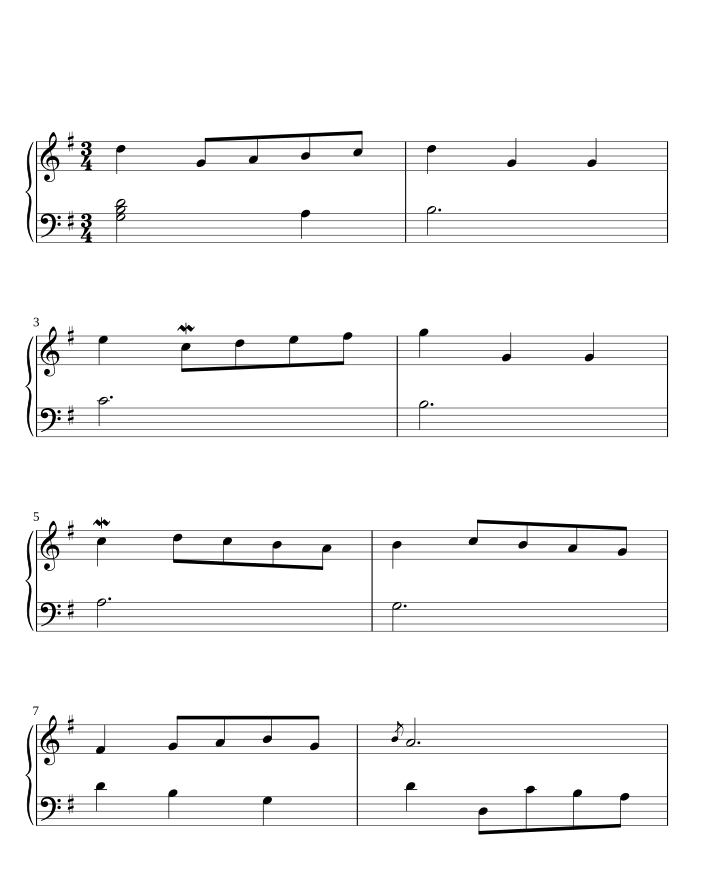
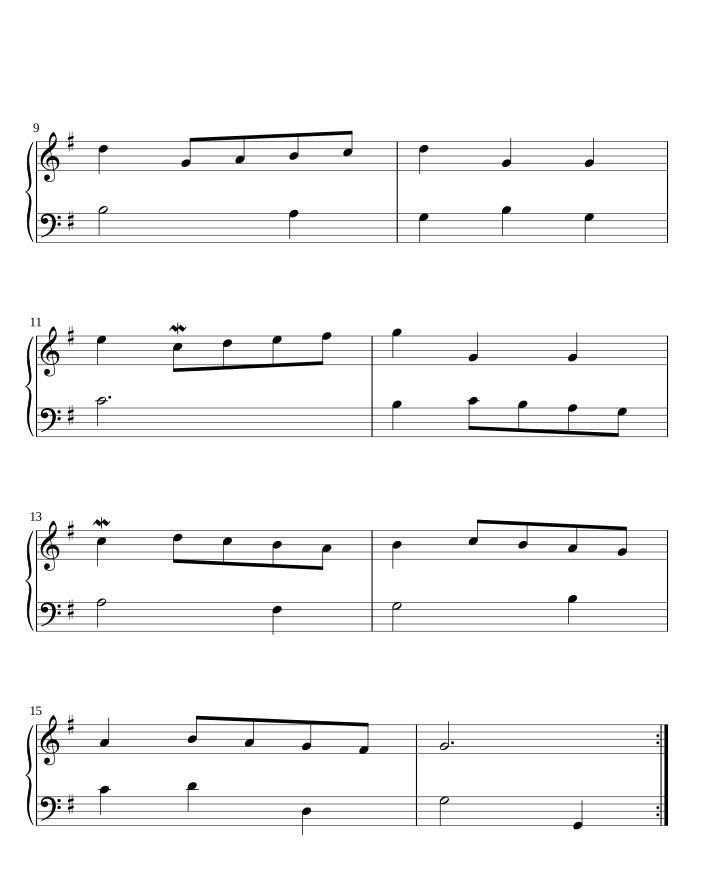
SheetScroll follows repeat signs, first and second endings, D.S. and coda. When you reach a jump, it moves to the page you are heading for, and it turns two beats before the end of that page. If you stop, go back or skip a repeat, it finds your place again, and tapping the bar you are on tells it at once. Listening is part of SheetScroll Pro.
Questions
What does D.S. al Coda mean?
Go back to the segno sign, play until the words To Coda, then jump to the coda section and play to the end.
What is the difference between D.C. and D.S.?
D.C. (da capo) goes back to the very beginning. D.S. (dal segno) goes back to the segno sign somewhere in the piece.
Do I play the repeats again after a D.C.?
Usually not. Unless the score says with repeats, take each repeat only once and play the second ending where one is marked.
How do first and second endings work?
On the first pass, play the bars under the 1. bracket and repeat. On the second pass, skip them and play the bars under the 2. bracket.
Can a page turner follow repeats and codas?
Some can. SheetScroll follows repeat signs, first and second endings, D.S. and coda, so the right page comes up after a jump.
Related
- Automatic page turnersEvery way to turn sheet music pages hands-free, from pedals to apps that listen, with the pros and cons of each and how a listening page turner decides.
- Turning pages at the pianoPractical ways pianists turn pages without a break: layout tricks, half-page turns, pedals, memorizing the turn and apps that listen.
- Chord charts and transposingHow to transpose a chord chart to a new key, work out capo shapes, read Nashville numbers and keep lyrics lined up over the chords. With worked examples.
- PianistsA sheet music app for pianists: it listens through the mic or a digital piano over MIDI and turns the page two beats early, never early. Free reader.
- Church musiciansKeep a service in order, follow every repeat and D.S. through the verses, and put chord charts in the singers' key. Free reader, hands-free turns with Pro.
- PianoFifteen free, public-domain piano pieces in teaching order, from three right-hand notes to Burgmüller. They listen and turn pages without Pro.