Am I too old to learn an instrument?
No. In a 2023 survey of 1,159 pianists run by a piano-lesson site, 82 percent of the novices said they had learned mainly as adults. The survey is self-reported and not a scientific sample, but it matches what teachers see: adult beginners are common.
Research on older beginners is encouraging. In one trial, 31 adults aged 60 to 85 with no musical training were assigned to six months of individual piano lessons or to a control group. The group that took lessons improved on two tests of thinking skills.
Age changes some things. Adults have less free time, and they hear how a piece should sound while their hands cannot yet play it, which makes the first months feel clumsy. Perfect pitch, the ability to name a note with no reference, is rarely gained after childhood, and playing well does not need it. Adults also bring things children lack: you choose the instrument and the music, you can follow a plan, and you know why you practice.
How long does it take to learn an instrument?
It depends on what you mean by learn. Playing a simple tune takes weeks. Playing well takes years. These steps are teachers’ common experience for 15 to 30 minutes of practice on most days. They are not measured results.
| When | What you can usually do |
|---|---|
| First two weeks | Hold the instrument, make a sound, and play a few notes with a steady beat. |
| Months 1 to 3 | Play a short tune from notation. Your hands or lips feel less strange. Bowed strings and winds may still sound rough. |
| Month 6 | Play easy one-page pieces and some simple songs, slowly. |
| Year 1 | Play short real pieces, read notation at a basic pace, and play with a recording or a friend. |
| Years 3 to 5 | Play at an intermediate level. For piano, one piano-lesson site’s author estimates four to five years to reach it. |
How long does it take to learn piano? Simple songs with both hands come within weeks to a few months. A page of real music in a classical style takes most adults a year or more. Keep the schedule loose and look at the last month, not the last day. For how to spend your minutes, see how long to practice.
What is the easiest instrument to learn as an adult?
The one you will keep playing. Easy at first and easy to master are different things, and the right first instrument is the one whose music you want to play. This table shows what is easy and what is hard in the first weeks of the eight instruments SheetScroll has courses for.
| Instrument | The first weeks | What is hard |
|---|---|---|
| Piano | Press a key and the note sounds. The notes are laid out in order in front of you. | Two hands doing different things, and reading two staves. |
| Guitar | A few notes or chords in the first days. | Sore fingertips at first, clean chord changes, and barre chords after some months. The SheetScroll course uses classical notation, with no tab. |
| Violin | Open strings and a steady bow, then the first finger patterns. | There are no frets, so you place every finger by ear. Tone is scratchy at first. |
| Cello | Open strings and a steady bow, in bass clef. | The same as the violin, on a larger instrument with a longer reach. |
| Flute | A clear tone takes a few days of blowing across the edge of the hole. Then the first three notes. | Breath control, and a steady tone in the second octave. |
| Clarinet | A first sound on the mouthpiece and reed, then the low notes. | Squeaks while the mouth is learning, and the break between the low and middle registers. |
| Alto saxophone | A first sound on the reed, then the first notes. | Tone and breath support. It is an E-flat instrument, so it sounds a major sixth lower than written. |
| Trumpet | Buzz the lips, then three notes on the valves. | Range and endurance. The lips tire, so short sessions work best. |
If you want the quickest start to music you can play and hear, piano and guitar usually give a tune soonest. If you love the sound of a violin or a trumpet, that is a better reason to pick it than ease.
Do I need a teacher, or can an app or videos teach me?
Adults use all of them. In the same survey, novice pianists named online resources and books (48 percent), a teacher (26 percent), a membership course (21 percent) and a gamified app (5 percent) as their main way to learn.
- A teacher sees what you cannot: posture, hand shape, bow hold and mouth position. This matters most on violin, cello, winds and brass, where the sound depends on technique that is easy to get wrong alone. Even one lesson a month helps.
- Videos, books and courses give an order and examples at your own pace. Many pianists and guitarists learn this way.
- Apps give structure and repetition, and some give feedback on notes and timing. A teacher still sees what an app misses.
SheetScroll’s courses do not replace a teacher. They give you real pieces in teaching order, and the page turns as you play. A teacher can use them as a setlist and add notes.
How do I start?
- Choose the instrument whose music you want to hear yourself play.
- Rent or buy an instrument that is set up to play. A poorly set-up one makes everything harder.
- Tune it before every session. A tuner shows whether each string or note is flat, sharp or in tune.
- Practice 15 to 30 minutes on most days, in one short session.
- Learn to read as you go. You do not need all the theory first. See how to read sheet music.
- Play a piece you like within the first weeks, even a simple version.
- Play with someone else when you can. It makes you keep the beat.
How do I stay motivated?
- Pick music you like, not only exercises.
- Keep a short, regular habit. A time of day you can repeat does more than a big plan.
- Set a goal you can check: a piece, a tempo, a date to play it for a friend.
- Record yourself every few weeks. You will hear progress you cannot feel.
- Expect plateaus, and change what you practice when one comes.
Which free courses does SheetScroll have for adult beginners?
Eight courses, one for each instrument in the table above, with 14 to 16 public-domain pieces each in teaching order, from the first notes. Their pieces listen and turn pages without Pro and without an account.
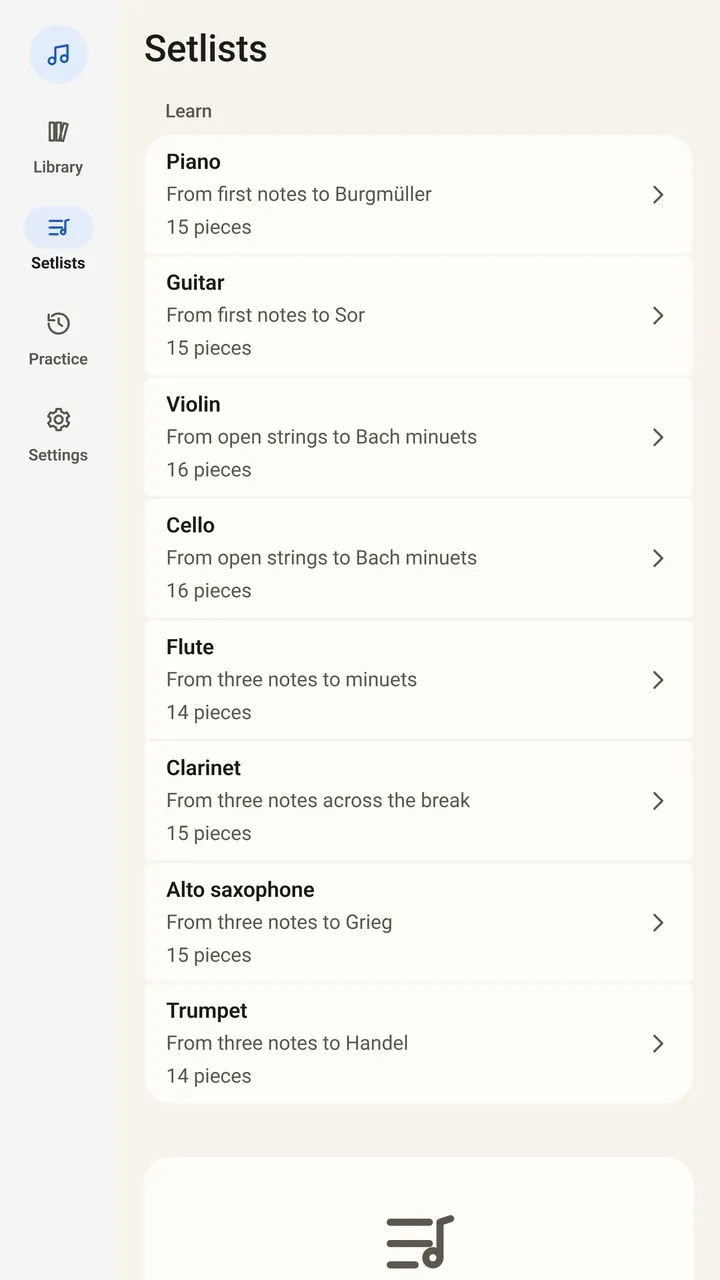
In Setlists, open Learn and tap your instrument. From an empty library, tap Learn an instrument. The pieces are imported, a setlist is made, and the first piece opens, ready to listen.
Questions
Is it too late to learn an instrument at 30, 40, 50 or 60?
No. Adults of every age learn instruments. Progress is slower than for a child with hours of free time, but a few months of regular practice gets you playing real tunes.
How long does it take to learn piano as an adult?
Simple songs take weeks to a few months. Real pieces take a year or more. One piano-lesson site’s author estimates four to five years to reach an intermediate level.
What is the easiest instrument to learn as an adult?
Piano and guitar give a tune soonest. Violin, cello and winds take longer to sound good. The easiest instrument is the one you will keep practicing.
Can I teach myself an instrument?
Yes, especially piano and guitar. Add a teacher, even for one lesson a month, if you play violin, cello, winds or brass, where technique is easy to get wrong alone.
How much should an adult beginner practice?
Fifteen to 30 minutes on most days. Short, regular sessions work better than one long session a week.
Do I need to read music to learn an instrument?
Not to start. Many guitarists use chords and tab, and many players learn by ear. Reading opens a much larger library of music, and the basics take weeks to learn.
Are SheetScroll’s courses free?
Yes. The eight courses are part of the free reader, and their pieces listen and turn pages without Pro or an account.
Related
- PianoFifteen free, public-domain piano pieces in teaching order, from three right-hand notes to Burgmüller. They listen and turn pages without Pro.
- GuitarFifteen free, public-domain classical guitar pieces in order, from strings 1 and 2 to Sor. They listen and turn pages without Pro.
- BeginnersEight free courses for piano, guitar, violin, cello, flute, clarinet, sax and trumpet. The pieces listen and turn the page as you play, with no Pro needed.
- How long to practiceHow long to practice piano, guitar or violin each day, how to practice well, and what to do when you stop improving, with the research behind it.
- How to read sheet musicLearn to read sheet music: the staff, treble and bass clef, note names, note values, rests, time signatures, key signatures and how to practice reading.
- Tuning your instrumentStandard tunings for guitar, bass, ukulele, violin, viola, cello and more, how to use a tuner or tune by ear, how winds and brass tune, and A440 vs 442.
Sources
- Pianote, survey of 1,159 pianists (2023), checked October 23, 2026
- Bugos et al., Individualized piano instruction in older adults, Aging & Mental Health (2007), checked October 23, 2026