How many minutes a day should I practice?
No study has found one right amount. It depends on your level and your goal. Teachers’ usual advice is a rule of thumb, not a research result.
| Level | A day | How to spend it |
|---|---|---|
| Beginner, first year | 15 to 30 minutes | One short session. A few things, done slowly and well. |
| Intermediate | 30 to 60 minutes | A warm-up, one piece in detail, one piece for pleasure. Split it in two if you can. |
| Advanced, or preparing for an exam or audition | 1 to 3 hours | In several sessions with breaks between them. More hours do not help once the quality has fallen. |
In a 2023 survey of 1,159 pianists by a piano-lesson site, 61 percent of the novices said a session lasts 15 to 45 minutes, and 27 percent of them practice every day. The survey is self-reported, so it shows what people do, not what works.
Is it better to practice a little every day or a lot at once?
A little, most days. Learning that is spread over several sessions is kept better than learning packed into one. A review of 317 experiments, all of them on recalling words and facts rather than playing music, found that spacing the study sessions out improved recall.
Five 20-minute sessions in a week are likely to do more than one 100-minute session. Short sessions also keep your hands, lips and attention fresh. When you only have ten minutes, use them. They still count.
What is deliberate practice, and does it work?
Deliberate practice means working on a specific weakness, with a clear goal and quick feedback, just beyond what you can already do. It differs from playing through pieces you know. The idea comes from psychologist Anders Ericsson’s 1993 study of 30 student violinists, in which the better players had practiced more alone.
Later work puts practice in proportion. A meta-analysis across many fields found that deliberate practice explained about a fifth of the differences in music performance. That is a large share, and it leaves most of the difference to other factors. A 2019 repeat of the violin study found a smaller link between practice and skill than the original.
The “10,000 hours” figure is not a threshold. It traces back to that one small study, where the best student violinists had practiced alone for roughly that long by age 20. It was an average, not a line anyone crossed. Your hours count, and how you spend them counts at least as much.
How do I practice effectively?
- Warm up for a few minutes: easy scales, open strings or long tones, slow and relaxed.
- Pick one goal for the session, such as bars 9 to 12 at a steady pulse without stopping.
- Play the passage slowly enough that you make no mistakes. Speed up only when it is clean.
- When you make a mistake, find the exact spot and the cause: a note, a shift, a rhythm or a fingering. Loop that spot until it is right several times in a row.
- Play the bars just before and after it, so the spot works inside the piece.
- Play the whole passage once at the end, and write down what is left for next time.
- End with something you enjoy.
A 2009 study watched 17 piano majors learn a hard three-bar passage. How long they practiced and how many times they repeated it did not predict how well they played it the next day. The three best players pinpointed the exact spot of each error, slowed down there, and repeated it until the error was gone. Repetition helps when each repeat is correct.
Should I practice one thing at a time or mix it up?
Many players work on one passage until it is perfect and then move on. The other way is to take short turns on two or three passages and come back to each. In a study of 10 advanced clarinetists, pieces practiced in the mixed schedule were rated better than pieces practiced one at a time, although the results varied across the three professional raters.
The study was small, so take it as a hint. Once a passage is clean, try rotating between two or three of them, five to ten minutes each.
Do breaks and sleep help?
Yes. Take a short break when your focus fades, and stop at pain. Aching hands, wrists or neck mean you should rest and ask a teacher about technique. See a doctor if pain stays.
Sleep helps too. In a study of 60 music students, those who learned a short melody in the evening played it better the next day after a night’s sleep. Learning a second melody right after the first removed that overnight gain, and replaying the first melody before leaving restored it. A reasonable reading is to finish a session on the piece you most want to keep, and not to follow it at once with a similar one.
What can I do when I stop improving?
Plateaus are normal. Progress flattens when what you practice has stopped being hard, or when a weakness is hiding. Change something.
- Slow down and look for a specific weak spot instead of playing through.
- Record yourself and listen back. You hear timing and tone that you miss while playing.
- Change the task: a new piece, a new key, one hand alone, a different tempo, or from memory.
- Set a goal you can check, such as bar 17 at 72 beats a minute, three times in a row.
- Book one lesson to find what you cannot see yourself.
- Rest for two or three days if you are tired or sore.
How can I track my practice and keep the habit?
Write down the date, the minutes, what you worked on and the tempo. A notebook is enough. The habit matters more than the tool.
SheetScroll has practice tools beside the music. In the player, tap Practice to loop hard bars (Select bars, then Loop these bars), set a Practice tempo, tap Count in, or follow the Right hand or Left hand alone. History shows your minutes per day over the last 7 days and in all, and Bars to work on, with the reason, such as a missed note, a rushed beat or a flat note.
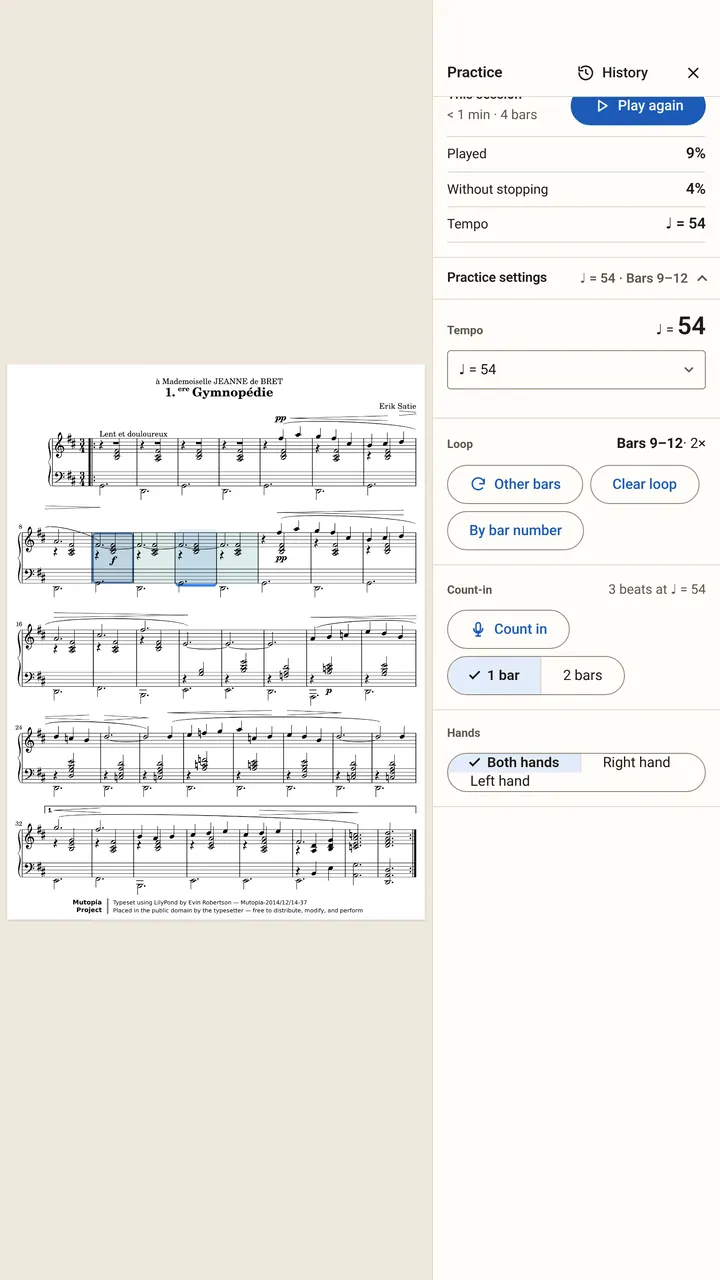
It measures as it listens and keeps the results, never audio. Practice that listens is part of SheetScroll Pro. The free reader has eight courses of pieces in teaching order to practice with.
Questions
How long should a beginner practice each day?
Fifteen to 30 minutes on most days is a good start for piano, guitar, violin or any other instrument. Add time as your pieces get longer, and keep each session focused.
Is 30 minutes of practice a day enough?
For most beginners and many intermediate players, yes. What you do in the 30 minutes matters more than the number: slow work on the hard bars, with a clear goal.
How many hours of practice does it take to get good?
There is no fixed number. The 10,000-hour figure traces back to a small study of top violin students, where it was roughly their average by age 20. A later repeat found a weaker link between hours and skill.
Is it okay to practice every day?
Yes, if it does not hurt. Take a day off now and then, and stop when you feel pain in your hands, wrists, neck or lips.
How do I practice when I have no time?
Use ten minutes on one goal, such as one hard passage played slowly. Short sessions most days work better than one long session you cannot fit in.
Does practicing slowly really help?
Yes. In a study of pianists learning a hard passage, the best players slowed down at the spot where they had made a mistake and repeated it until it was right.
Related
- Sight-readingHow to get better at sight-reading: what to check first, keeping the pulse, reading ahead, reading patterns, and a daily practice plan with free music.
- Learning as an adultIt is not too late. What to expect in the first months, which instrument is easiest to start, and whether you need a teacher, an app or videos.
- How to read sheet musicLearn to read sheet music: the staff, treble and bass clef, note names, note values, rests, time signatures, key signatures and how to practice reading.
- Practice toolsLoop hard bars, practice one hand at a time, set your own tempo and count in, then see what to work on in your practice history.
- StudentsFree courses, free sheet music, loops, hands-separately practice and tempo history. A sheet music app for students that listens and turns the page.
- PianoFifteen free, public-domain piano pieces in teaching order, from three right-hand notes to Burgmüller. They listen and turn pages without Pro.
Sources
- Pianote, survey of 1,159 pianists (2023), checked October 23, 2026
- Cepeda et al., Distributed practice in verbal recall tasks, Psychological Bulletin (2006), checked October 23, 2026
- Macnamara and Maitra, revisiting Ericsson, Krampe and Tesch-Römer (1993), Royal Society Open Science (2019), checked October 23, 2026
- Macnamara, Hambrick and Oswald, deliberate practice meta-analysis, Psychological Science (2014), checked October 23, 2026
- Duke, Simmons and Cash, It’s not how much; it’s how (2009), as summarized by Music Mark, checked October 23, 2026
- Carter and Grahn, blocked and interleaved practice in clarinetists, Frontiers in Psychology (2016), checked October 23, 2026
- Allen, sleep and learning a melody, Psychology of Music, as reported by ScienceDaily, checked October 23, 2026